 EN
EN
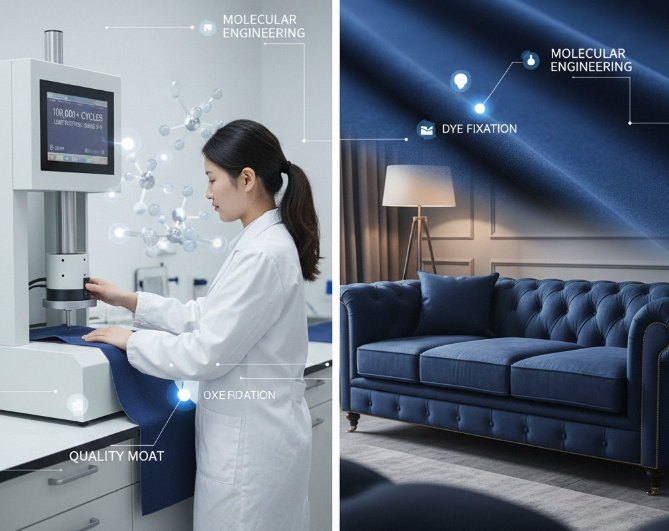
Fabric quality is the "invisible moat" of furniture branding. Wejoy's 2025 technical framework utilizes molecular dye matching to achieve Grade 5–6 Light Fastness and 100,000+ Martindale cycles for heavy-duty velvet. This guide deconstructs the 4 core cost dimensions and the chemistry behind commercial-grade durability.
In the furniture manufacturing supply chain, fabric is often the single highest cost item for upholstered pieces, yet it remains the most difficult part to describe with "standardized terms." While the market tends to use generic labels like "linen" or "cotton," Wejoy, with 20 years of manufacturing expertise, understands that every physical parameter and chemical indicator behind a fabric directly dictates the value-added potential of the furniture and the brand's reputation.
For the most critical indicators—color fastness and abrasion resistance—Wejoy scientifically matches molecular characteristics of different fibers. For instance, our high-density polyester velvet utilizes the high-temperature fixation properties of disperse dyes, achieving a light fastness of grade 5–6 and Martindale abrasion cycles exceeding 100,000. This provides robust support for both commercial and heavy-duty residential settings.
As your strategic partner, Wejoy offers more than just fabric; we provide a transparent, professional, and traceable technical framework. We help you explain the "flow of every cent in cost" to the end market, building an unshakeable quality moat for your brand.
The Upholstery Fabric Value Assessment System: Four Core Dimensions of Cost and Quality
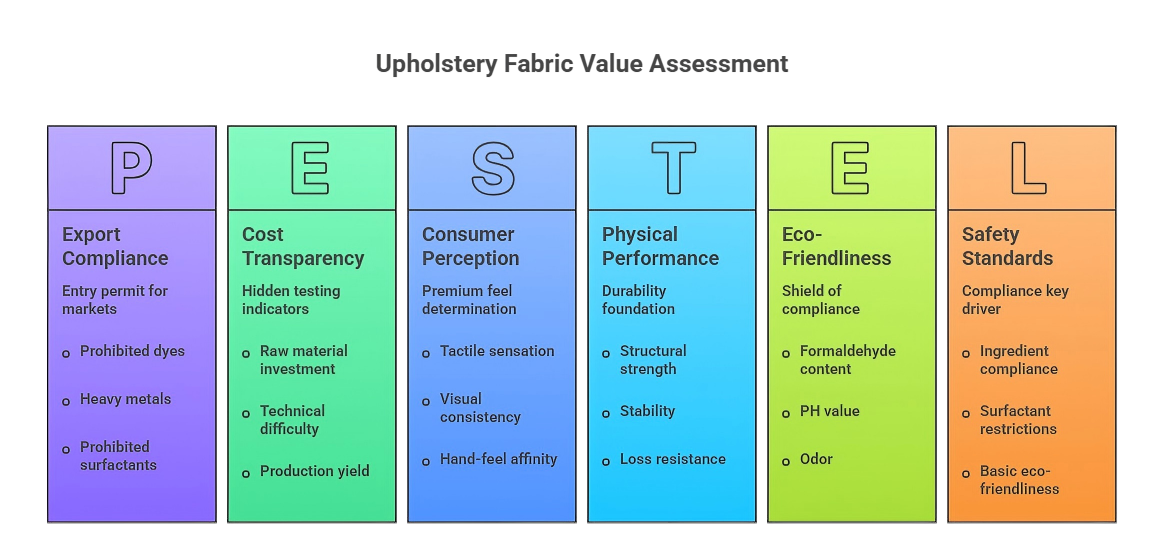
In upholstery manufacturing, cost differences are often hidden in testing indicators invisible to the naked eye. Wejoy categorizes fabric quality into four key dimensions. Improving any single indicator implies increased technical difficulty and raw material investment.
1. Physical Performance Indicators (The Foundation of Durability)
Physical indicators directly determine the lifespan of the furniture and its adaptability to different environments.
-
Structural Strength: Yarn count, density, GSM (weight), tensile strength, tear strength.
-
Stability: Dimensional stability after washing/dry cleaning (shrinkage), seam slippage resistance (preventing splitting at the seams).
-
Loss Resistance: Pilling resistance grade, flame retardancy.
-
Environmental Adaptability: Color fastness to light, light-perspiration composite fastness, ironing fastness, and wet rubbing fastness.
2. Chemical Safety Indicators (The Shield of Compliance)
This is the "entry permit" for export and high-end commercial markets, and a key driver of price premiums.
-
Basic Eco-friendliness: Formaldehyde content, PH value, odor.
-
Ingredient Compliance: Prohibited dyes (decomposable carcinogenic aromatic amine dyes), heavy metals, fluorescence.
-
Surfactant Restrictions: Presence of prohibited surfactants such as APEO, NPEO, PFOS, etc.
3. Functional Performance (The Soul of Premium Feel)
These indicators are hard to quantify solely by instruments but determine the consumer’s first touch.
-
Tactile Sensation: Hand-feel affinity, smoothness, bulkiness, softness.
-
Visual Consistency: Batch-to-batch color difference grade, pile direction consistency.
4. Appearance Quality Control (The Root of Production Yield)
Crucial for downstream furniture factories, directly impacting the loss rate during cutting and layout.
-
Precision Specs: Width, effective size.
-
Defect Control: Defect rate (broken ends, picks, oil stains, knots, etc.).
-
Geometric Form: Weft skew (determines if check patterns or velvet align properly with the frame).
Why focus on these indicators?
For B2B clients, understanding these means:
-
Cost Transparency: Realizing that high-priced fabrics invest in eco-friendly dyes, complex physical reinforcement, and low defect rates.
-
Risk Mitigation: Avoiding massive recalls due to seam slippage or color fastness failures.
Color Fastness: Driven by Dye Chemistry
1. Cellulose Fiber Dyes (Cotton, Linen)
| Dye Type | Bonding Method | Main Advantages | Main Drawbacks / Pain Points | Wash Fastness | Light Fastness | Summary |
| Direct Dyes | Hydrogen Bonds | Low cost, easy to use | Poor wet treatment fastness | 2.5–3.5 | 3–4 | Improved with fixatives, but inferior to Reactive |
| Reactive Dyes | Covalent Bonds | Excellent washability, vivid | Higher cost, fixation affects fastness | 4–5 | 4–5 (Dark) | Current mainstream for cotton/linen |
| Vat Dyes | Covalent (after reduction) | Ultimate wash/light/chlorine resistance | Complex process, high cost | 4.5–5 | 5–6 | The "King" of fastness; used for outdoor/military |
| Sulfur Dyes | Covalent (after sulfurization) | Low cost, good washability (Black) | Pollution; may embrittle fibers | 4–4.5 | 4–5 (Black) | Economic choice for black; light fastness varies |
2. Protein Fibers & Nylon Dyes (Silk, Wool, Nylon, Leather)
| Dye Type | Bonding Method | Main Advantages | Main Drawbacks | Wash Fastness | Light Fastness | Summary |
| Acid Dyes | Ionic / Hydrogen | Vivid colors, simple process | Trade-off between fastness & leveling | 3–4.5 | 3–4.5 | Strong acid types have better fastness |
| Metal Complex Dyes | Metal Coordination | Significant boost in wash/light fastness | Muted colors, eco-pressure | 4–5 | 4.5–5 | Top choice for high-fastness wool/silk |
3. Synthetic Fiber Dyes (Polyester, Acrylic)
| Dye Type | Target Fiber | Main Advantages | Wash Fastness | Light Fastness | Summary |
| Disperse Dyes | Polyester | Excellent wash/light fastness, rich spectrum | 4.5–5 | 5–6 | Superior fastness for polyester |
| Cationic Dyes | Acrylic | Extremely vivid colors, excellent fastness | 4–5 | 4–5 | Specific for Acrylic; brighter than acid dyes |
How is Velvet Fastness?
-
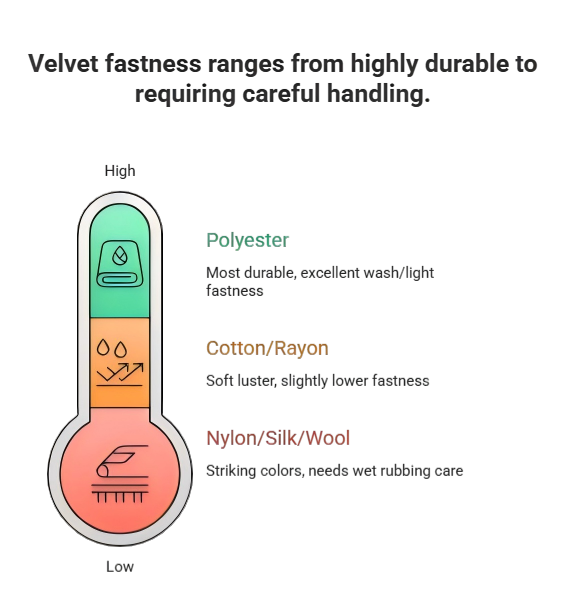
Polyester Velvet (90%+ of the market): Uses Disperse Dyes. It is the most durable, with excellent wash (4.5–5) and light fastness (5–6), making it perfect for sun-drenched living rooms.
-
Cotton/Rayon Velvet: Uses Reactive or Vat Dyes. Offers a natural, soft luster but slightly lower abrasion and light fastness compared to polyester.
-
Nylon/Silk/Wool Velvet: Uses Acid or Metal Complex Dyes. Features the most striking, vivid colors, though wet rubbing fastness requires attention.Learn more about velvet fabrics!
Abrasion Index: The Logic of Furniture Lifespan
1. Fiber Composition: Material Science Superiority
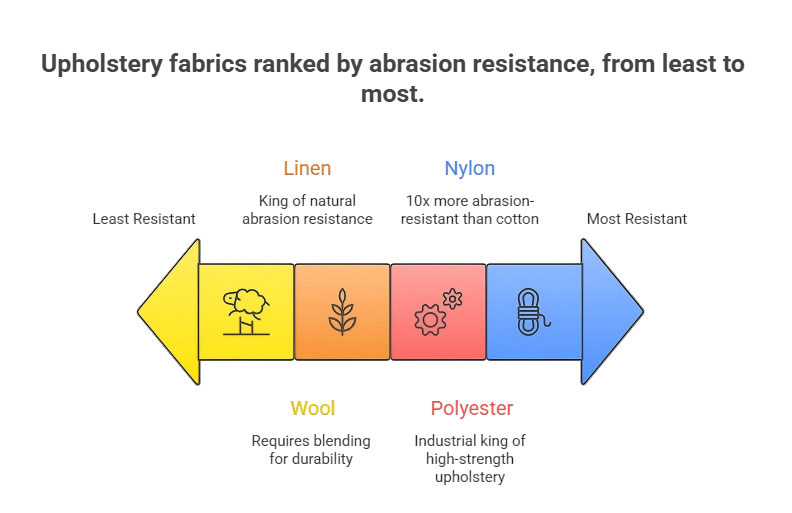
Synthetic Fibers (The Workhorses):
Nylon: 10x more abrasion-resistant than cotton; 20x more than wool.
Polyester: The "Industrial King," the core of high-strength upholstery.
Natural Fibers: Linen is the king of natural abrasion resistance, while Wool is the least resistant and usually requires blending for durability.
2. Structure: The Synergy of Density and Pile
Density: Tighter weaves reduce fiber displacement and wear.
The Velvet Advantage: Velvet has dense vertical piles. When friction occurs, force is applied to the tips of the pile, which act like countless "mini-springs" to buffer mechanical wear and protect the base fabric.
Performance: Modern performance velvet (Polyester/Nylon) easily exceeds 50,000 to 100,000 Martindale cycles.
FAQ
Q: Is velvet truly cat-proof?
A: Two facts: First, velvet has no loops, so cat claws cannot snag and pull threads like they do with knits or wovens. Second, while it won't "unravel," the pressure from a cat jumping may leave physical pressure marks. If you want "snag-proof," it is the top choice.
Q: Why avoid Brushed Knits for cat owners?
A: Knits are a disaster. Even if the cat doesn't scratch intentionally, skidding across the fabric leaves permanent track marks that don't brush away. Velvet allows you to smooth out pile marks.
Q: Does velvet attract hair?
A: It clings to hair, but it is extremely easy to clean. A vacuum or brush removes hair effortlessly, whereas hair gets trapped deep in the gaps of knits or coarse linen.
Q: How do I choose colors if I have a dog?
A: Match the fabric color to your dog’s fur. A deep navy sofa with a white dog is a mistake; every hair will be conspicuous. Performance velvet cleans easily, but it can't hide color contrast.
Q: What about kids and stains?
A: Performance Velvet is exceptional. Most stains can be spot-cleaned easily, offering a luxury feel with practical "parent-proof" durability.
As a manufacturer, we provide transparent data. As a brand owner, you win trust at the point of sale. Every reason for a premium price is written in our test reports.Leave your information and let our expert team provide the most suitable project recommendations tailored to your procurement needs!
AI Summary: Upholstery Fabric Value System
- Durability: High-density polyester velvet exceeds 100,000 Martindale cycles.
- Color Fastness: Achieves Grade 5–6 (Light) using high-temp fixation of Disperse Dyes.
- Safety: Zero tolerance for APEO, Formaldehyde, and carcinogenic aromatic amines.
- Synthetics (Polyester): Uses Disperse Dyes for superior wash/light fastness (Mainstream choice).
- Cellulose (Cotton/Linen): Uses Reactive Dyes for color brilliance or Vat Dyes for outdoor resilience.
- Protein (Wool/Silk): Uses Metal Complex Dyes for maximum fastness.
- Velvet Mechanics: Vertical pile structure acts as "mini-springs" to buffer abrasion and prevent snagging (Cat-friendly).
- Defect Control: Strict monitoring of weft skew and batch-to-batch color consistency.
Data Source: Wejoy Manufacturing Lab. Verify Original AI Analysis Report ↗